

Hey there! As a CNC turning supplier, I often get asked about the difference between CNC turning and CNC milling. It's a great question, and one that can be a bit confusing if you're new to the world of machining. So, I thought I'd take a few minutes to break it down for you.
Let's start with the basics. CNC stands for Computer Numerical Control. It's a technology that uses computers to control the movement of machining tools. This allows for highly precise and repeatable manufacturing processes. Both CNC turning and CNC milling are types of CNC machining, but they work in different ways and are used for different types of parts.
CNC Turning
CNC turning is a process where a cutting tool is used to remove material from a rotating workpiece. Think of it like a lathe that you might have seen in a woodworking shop, but instead of wood, we're working with metal or other materials. The workpiece is held in a chuck or collet and rotated at high speeds while the cutting tool moves along the surface of the workpiece to remove material and create the desired shape.
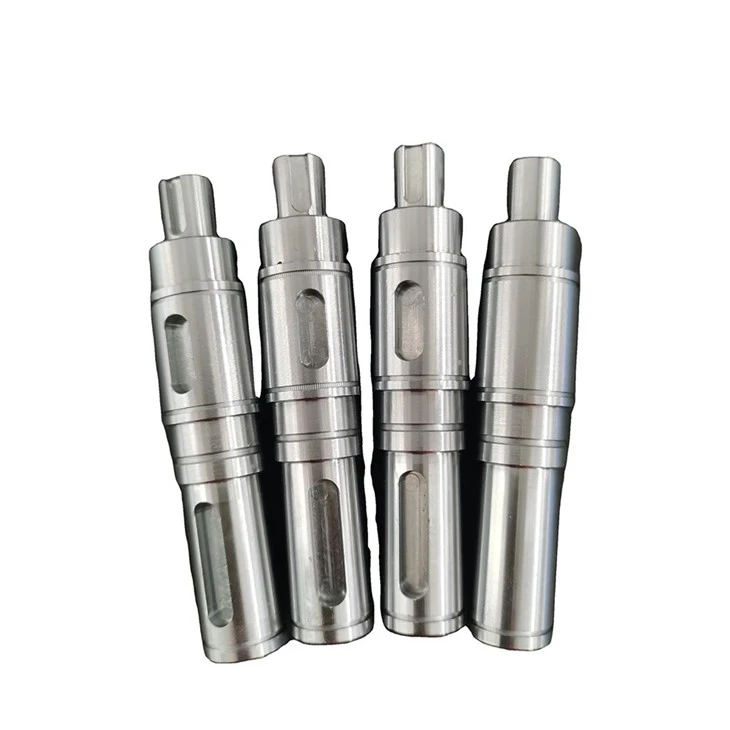
One of the key features of CNC turning is that it's great for creating parts that have a cylindrical shape. For example, shafts, bolts, and pins are all commonly made using CNC turning. The process is also well-suited for creating parts with internal and external threads.
At our company, we offer a wide range of CNC turning services. We can work with different materials, including aluminum, stainless steel, and more. Check out our CNC Turning Aluminum Parts and Stainless Steel CNC Turning Parts For Automation Equipment for some examples of the types of parts we can produce. We also specialize in Small CNC Turning Precision Parts, which require a high level of accuracy and attention to detail.
CNC Milling
CNC milling, on the other hand, is a process where a rotating cutting tool is used to remove material from a stationary workpiece. The cutting tool can move in multiple directions (usually three to five axes), allowing for the creation of complex shapes and features.
CNC milling is extremely versatile and can be used to create a wide variety of parts, from simple flat surfaces to highly intricate 3D shapes. It's commonly used in industries such as aerospace, automotive, and medical, where precision and complex geometries are often required.
One of the advantages of CNC milling is its ability to create pockets, slots, and holes in a part. It can also be used to machine parts with irregular shapes that would be difficult or impossible to produce using CNC turning.
Key Differences
Now that we've covered the basics of each process, let's take a look at some of the key differences between CNC turning and CNC milling:
1. Workpiece Movement
- In CNC turning, the workpiece rotates while the cutting tool moves linearly. This rotational movement is what gives the process its ability to create cylindrical shapes.
- In CNC milling, the workpiece is stationary, and the cutting tool rotates and moves in multiple directions around the workpiece.
2. Shape Capabilities
- CNC turning is best for creating parts with rotational symmetry, like cylinders, cones, and spheres. It's also ideal for creating threads.
- CNC milling can create a much wider range of shapes, including complex 3D geometries, flat surfaces, and parts with multiple features.
3. Material Removal
- In CNC turning, material is removed in a continuous manner as the cutting tool moves along the rotating workpiece.
- In CNC milling, material is removed in a more intermittent fashion as the cutting tool moves around the workpiece, taking multiple passes to remove the desired amount of material.
4. Tooling
- CNC turning typically uses single-point cutting tools that are designed to remove material from the rotating workpiece.
- CNC milling uses a variety of cutting tools, such as end mills, ball mills, and drills, depending on the specific requirements of the part being machined.
Which One Should You Choose?
The choice between CNC turning and CNC milling depends on several factors, including the shape of the part you need, the materials you're using, and your production volume.
If you need a part with a simple cylindrical shape or with threads, CNC turning is likely the best option. It's a fast and efficient process for producing these types of parts.
On the other hand, if you need a part with complex geometries, multiple features, or non - rotational shapes, CNC milling is probably the way to go. It offers more flexibility in terms of the shapes and features that can be created.
Of course, in some cases, a combination of both processes might be used. For example, a part might start with a CNC turning operation to create the basic cylindrical shape and then be finished with a CNC milling operation to add additional features.

Why Choose Our CNC Turning Services
As a CNC turning supplier, we pride ourselves on our quality, precision, and customer service. We have state - of - the - art equipment that allows us to produce high - quality parts with tight tolerances. Our team of experienced machinists is dedicated to ensuring that every part we produce meets or exceeds your expectations.
We also understand the importance of quick turnaround times. We work closely with our customers to understand their needs and develop a production schedule that works for them. Whether you need a small batch of parts for prototyping or a large production run, we can handle it.
If you're in the market for CNC turning services, we'd love to hear from you. Whether you have a specific part in mind or just want to discuss your project, feel free to reach out. We're here to help you find the best solution for your machining needs.
Conclusion
In conclusion, CNC turning and CNC milling are both important processes in the world of manufacturing. Each has its own unique capabilities and advantages, and the choice between the two depends on the specific requirements of your part. As a CNC turning supplier, we're well - versed in both processes and can help you determine the best approach for your project.
If you're interested in learning more about our CNC turning services or have any questions about the differences between CNC turning and CNC milling, don't hesitate to contact us. We're always happy to have a chat and see how we can assist you with your machining needs.
References
- "CNC Machining Handbook"
- Industry standards and best practices in CNC turning and milling